
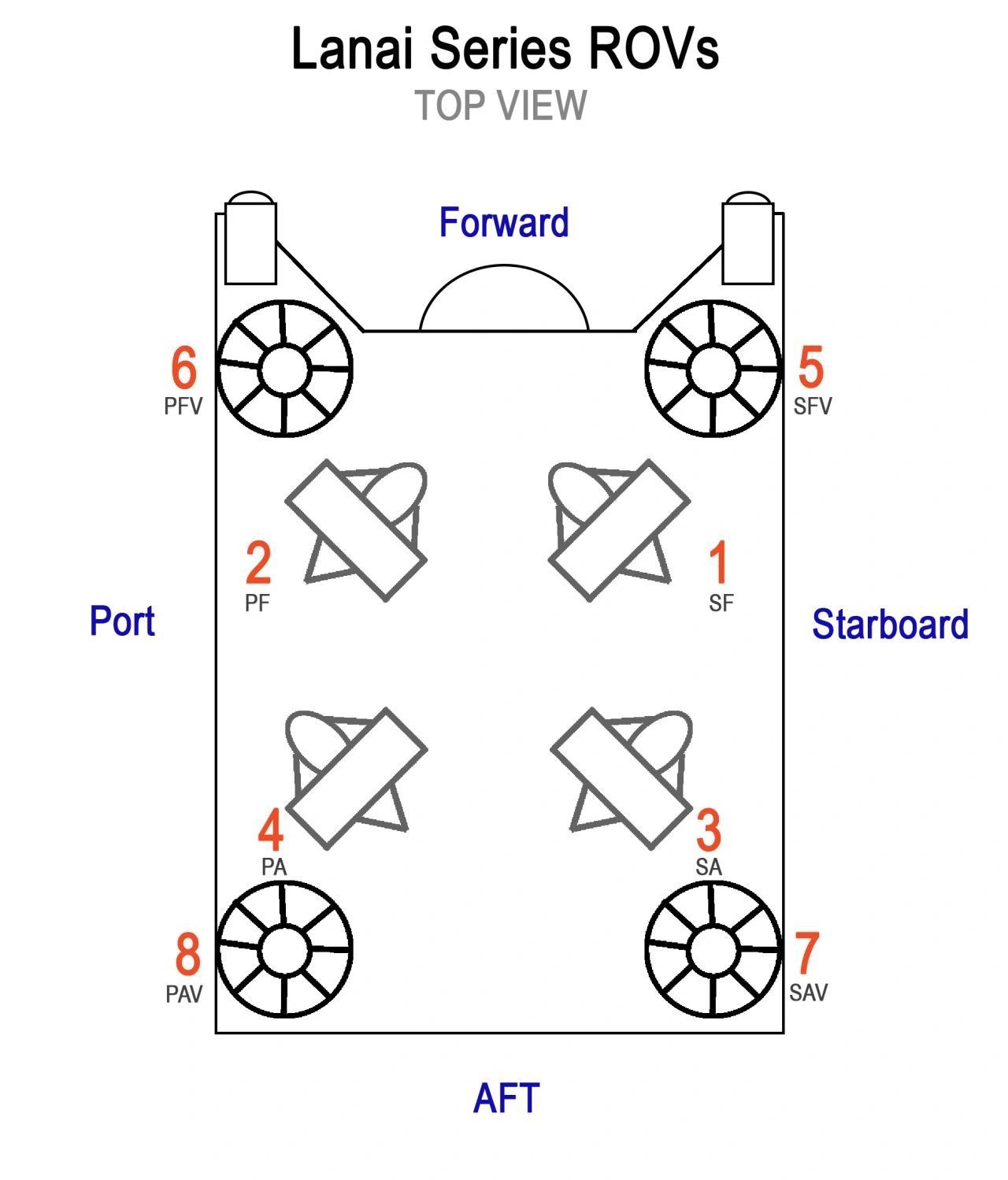
Thrusters are to an ROV what Jet Engines are to a 747. The ROV needs the right number and specs to operate properly. Here are 10 rules ("more like guidelines") for selecting the appropriate thrusters. This assumes we are purchasing off the shelf electric thrusters:
- It is a process of elimination and no one unit will work perfectly.
- 500 Newtons of thruster per 1 square meter ROV cross sectional area is a good starting point.
- Brushless thruster motors with "sensorless" controllers are generally best, but they require a good "motor controller" or Electronic Speed Controller (ESC) to operate.
- Select thruster/controller combination for the power system available. 12V, 24V, and 48V will be most common for small ROVs.
- Account for maximum thruster/controller current. 8 X 40A = is enough power to start a truck and melt large conductors.
- Larger and slower propellers (props) are nearly always more efficient.
- "Power Management" by limiting either maximum command, adjusting voltage, or be prepared to handle max power X number of thrusters.
- Maintain cooling - do not bunch up high current cables inside a small enclosed space. Use good water flow.
- Select a control method easy to implement. Analog voltage (0-10V for instance), Pulse width modulation (PWM), RS485, and CANBUS are all common.
- Pay attention to connectors and cable length. Cables should be run cleanly and well secured, and connectors should make the thrusters easy to change, as they sometimes need to be replaced.
Bonus - Pay attentional to propeller direction of rotation. The torque generated is not insignificant and this can be counteracted by balancing torques from different motors (i.e. half clock-wise and half anti-clockwise).