
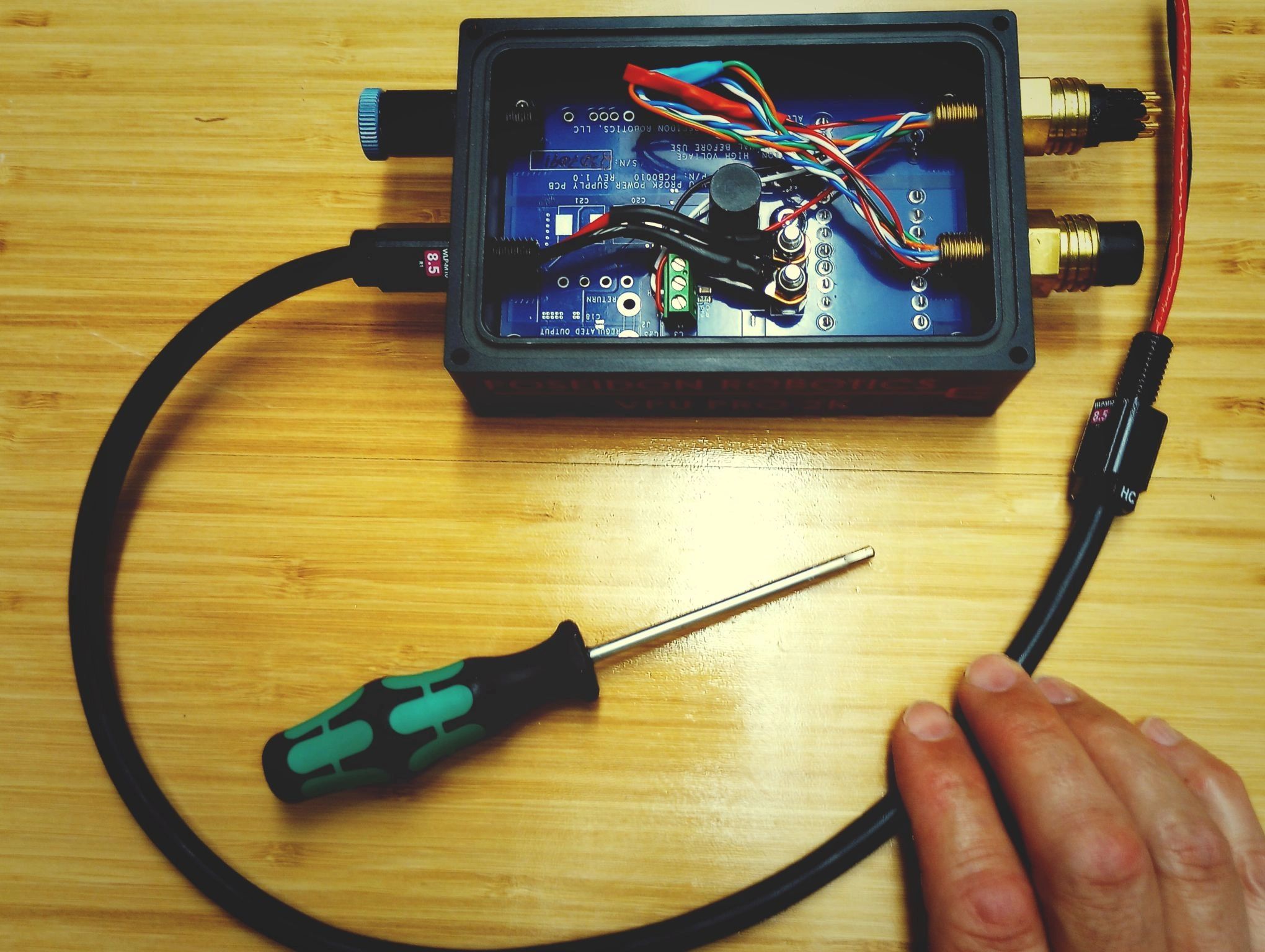
10 tips to get power to the bottom of the ocean
ROVs are generally power hungry, and they already need a tether for communication and control, so why not send power down there? In many cases, the ROV must remain submerged for days or weeks at a time, such as surveying subsea power cables, so power is a must. Here are some tips:
- Determine how much power is needed at the vehicle first, then tether losses, then add a bit to the surface supply.
- For 6, 7 and 8 thruster systems, enough power to run all thrusters at 100% plus all accessories is idea, but 10% more is good and 30% less is sometimes acceptable.
- For 3, 4, and 5 thruster systems, have power to run everything at 100%.
- Cables have resistance, the longer/smaller the cable, the higher the resistance and the greater the power loss. Increase the tether voltage until the tether conductor diameter and operating voltage are both reasonable.
- Power converters, tethers, connectors, and safety equipment come in discrete voltage ranges, select the highest common tether voltage that will keep power losses between 10 and 40%. Common ranges are:
a. 48-72VDC - suitable for very small systems and short tethers only
b. 120-240VAC - small vehicles <1kW and tethers < 300m
c. 300-400VDC - common ROVs <5kW and tethers <1km
d. 440-660VAC - common for medium sized ROVs, tether < 500m
e. 600-1,000VDC - common for medium ROVs, <10kW, tether <1km
f. 3,000-6,000VAC - Work class and small/med deep ROVs, tether >1km
- NEVER use mains AC voltage directly, always use an isolation transformer and earth leakage or line isolation monitor and circuit breaker! The ROV must shut off if more than about 10-30mA leaks into the water. DC supplies must also be isolated and have an isolation monitor ($$).
- "It's cold in the ocean" use the subsea housing to dissipate heat.
- "Power management" is critical to ensure the ROV cannot draw more power than can be provided. If the supply is smaller than the total possible load, it must be able to reduce voltage or the flight control software must be able to limit the power required by the vehicle. For this reason, ridged regulation isn't desirable.
- Maximizing the power density is critical to reducing costs, most off the shelf solutions are too big. Use a good DC:DC converter, such as VICOR DCM or BCM series, and design an application specific PCB/housing.
- Testing is critical. Changes in tether length, accessory power, or the ship's supply source can and will cause unforeseen problems. Build a resistive load bank for bench testing, buy the actual tether to be used, and invest in a good Oscilloscope to identify potential problems.