
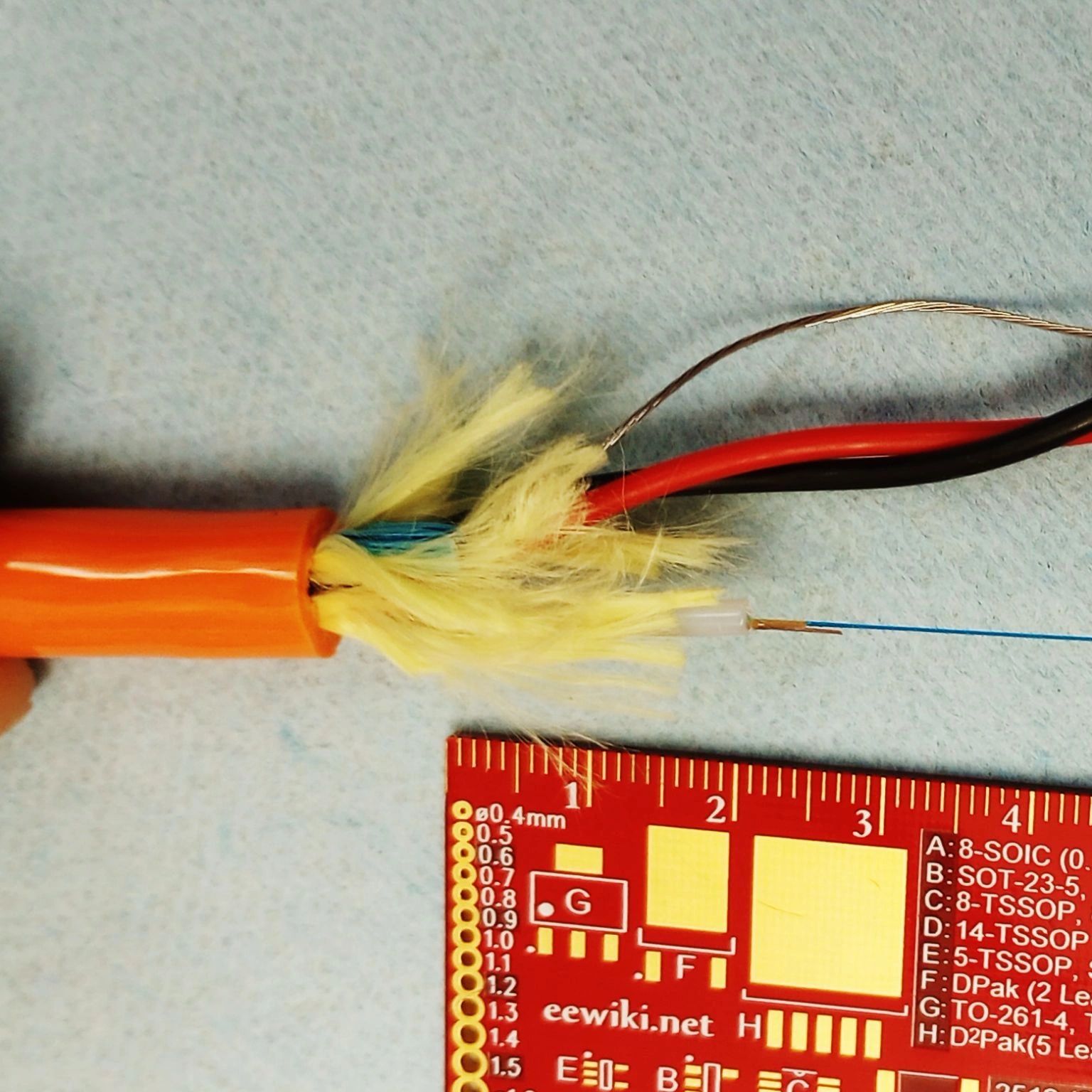
10 Tips to get started using unlimited bandwidth:
- More often than not, a custom design is required, but this can be <6 weeks.
- Make sure it's strong enough to hold ~5x the launch weight of the ROV.
- Power conductor size is still critical, but noise is not a concern.
- Keep the tether design balanced or use filler material to fill voids.
- Fibers should be in a gel-filled plastic "buffer tube" for protection.
- Remember the bare earth wire and preferably foil shielding for safety.
- Conductors/buffer tube should be spiraled to allow strength members to tighten before conductors/fiber.
- For shallow water, foamed Polyurethane jacket with smooth outer layer.
- Single mode Fiber only. Multi-mode is old-school and limited.
- For selecting a F/O tether, please contact us info@poseidonrov.com
Bonus. Single "pass" F/O sliprings with copper passes of 480V and up to 20A or reasonably quality are relatively cheap (~$1,000 USD). To get 4 optical passes + the electrical conductors in a high quality slipring could cost $50,000 USD or more. Therefore, select F/O modems that use only a single fiber for both both up-link and down-link (typically 1310nm and 1550nm wavelengths).