
Water utilities and hydro operators have a lot of infrastructure that sits underwater and out of sight: raw water intakes, pipelines, tanks, culverts, and penstocks. Getting eyes on it often means draining a structure, sending a diver into a confined space, or waiting for a shutdown. A compact, surface-powered ROV gives you another option.
Size is the first question
Utility access points are often small. Midway was designed around that constraint. It is 10 in in diameter, 16.9 in long, and 18 lb in air, and it fits through a 12 in opening. The production hull is frosted orange glass-reinforced polymer with matte black skids and a carry handle on top for handling and launch. Midway is built to reach inaccessible areas and can fly through a pipe.
That size is what makes pipes, tanks, culverts, and intakes realistic work for a single vehicle. For a longer confined run, such as a penstock, the questions to check are the same: the clear opening, the length of the tether, and whether the water is clear enough for the camera or calls for sonar. Midway's stock tether is 9 mm OD copper, 100 m (about 330 ft) in the standard package and available up to 300 m (about 980 ft), with a MacArtney SubConn 8-pin connector. The vehicle is rated to 1,000 ft, so in most utility work, depth is rarely the limit. Access and tether length usually are.
Control inside a pipe or intake
Inside a pipe, an intake structure, or another tight space, the vehicle has to hold position and make small moves without bouncing off the walls. Midway uses six Subseatronics A10 thrusters: four lateral at 45° and two vertical. That layout is there for precise control in tight spaces, which is the whole point of a 10 in vehicle.
Seeing the condition of the asset
Inspection is about seeing the condition of the asset and recording it. Midway carries a Blue Robotics 4K camera with tilt and two 1,500 lumen lights as standard. An auxiliary 1080p camera is available if you want a second view. The SPU-Lite console's 15.6 in, 1,000 nit screen keeps the picture readable on site.
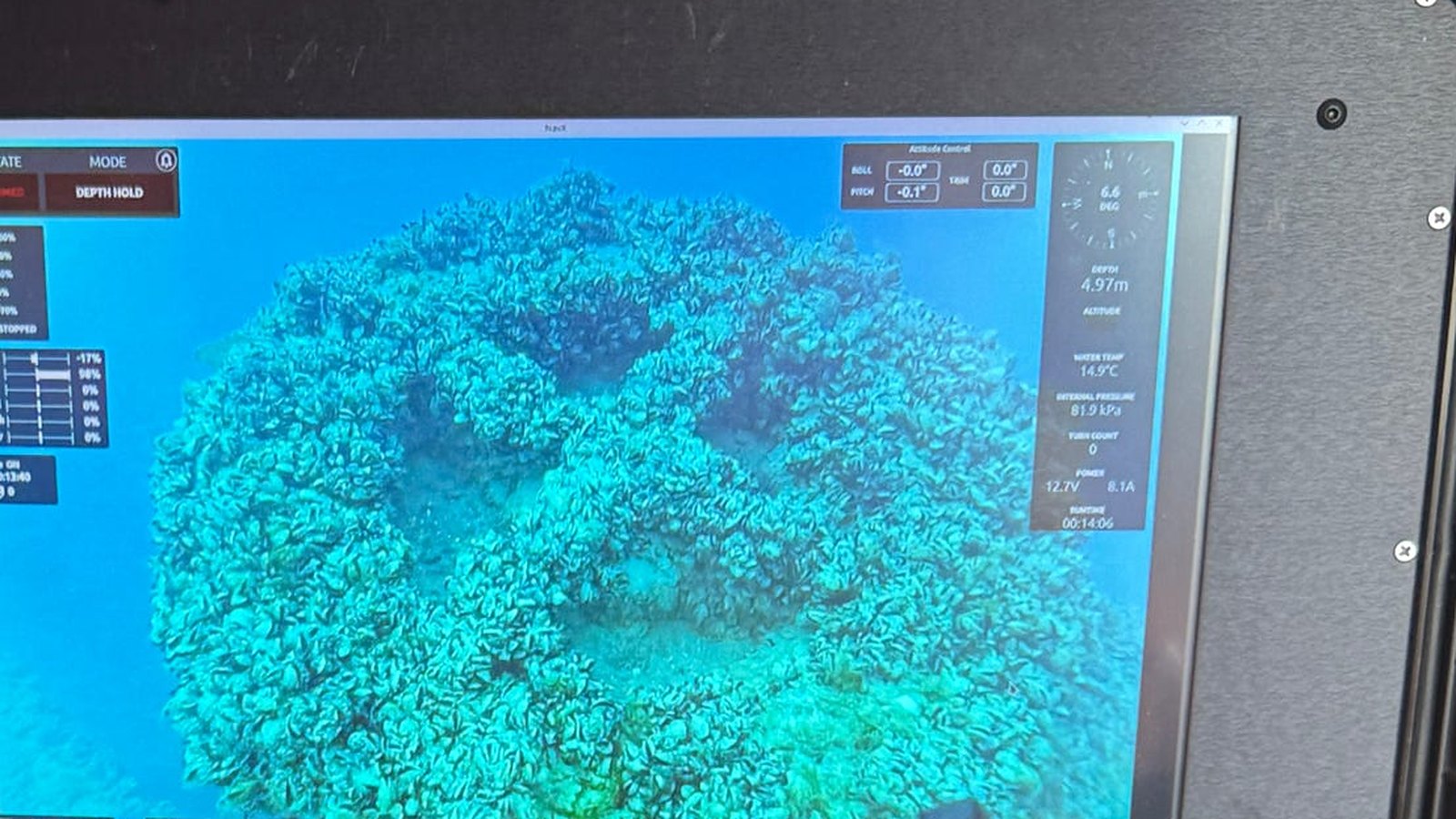
Fouling and debris are a common reason to look. The photograph at the top of this post is live Midway video, shown on the SPU-Lite console, of a mussel-covered surface during an August 2026 dive on Lake Michigan. That dive was a field day, not an intake inspection. It is still a fair example of the close, well-lit view you want when you are checking an intake, a pipe wall, or other submerged structure for growth and debris.
When the water is turbid, the camera alone may not be enough. Midway's top-front hull piece is interchangeable, so you can fit an optional imaging sonar in the nose: Oculus M series, Cerulean Sonar 450 FS, Blue Robotics Ping360, or Tritech Gemini iM series. Sonar is an add-on. The standard nose is rounded and carries none.
Power for a long day of inspections
Midway is powered from the surface. The SPU-Lite console runs on 90–260 VAC (15 A max, 50/60 Hz) and sends 400 VDC down the tether. On the vehicle, an industrial Vicor power converter provides 24 V, with 1 kW of ROV power and 100 W of accessory power. Two Ethernet (10/100) AUX ports and one RS485 port, each with 12 or 24 V, leave room for additional sensors.
The full specification for Midway is on the product page, including hull, camera, lights, and package contents.
The complete package
The complete Midway system is $29,500: the basic ROV, surface console, tether, cases, and a basic tools and spares kit. Lead time is about six weeks, with a 2-year limited warranty. Midway is made in the USA, and we sell direct.
If you have a specific intake, pipe, or penstock in mind, request a demo and include the access dimensions. We will tell you plainly whether Midway is a fit.