
Midway is a compact inspection-class ROV, and every complete system is made in the USA. It is small — 10 in in diameter, 16.9 in long, 18 lb in air, and rated to 1,000 ft — but it is not a sealed, disposable shell. The way it goes together is the reason it can be serviced, reconfigured, and supported after it leaves the shop.
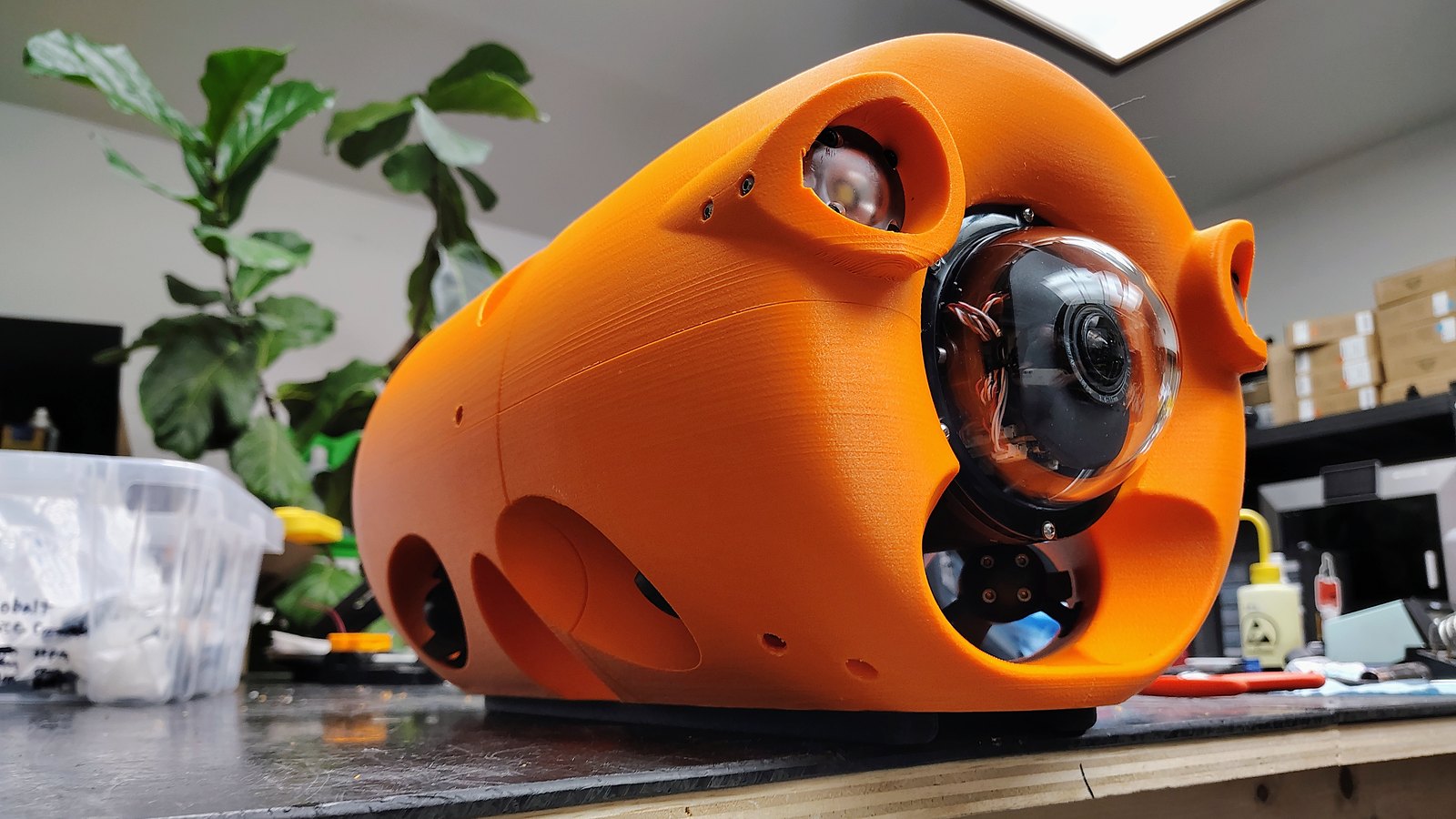
The photograph at the top of this post shows a production Midway on the workbench: a frosted orange glass-reinforced polymer hull, the front camera dome, and the two lights. That is the vehicle that ships.
A hull that comes apart
The production hull is frosted orange glass-reinforced polymer with matte black skids. It is built as a four-piece frame: top front, top back, bottom front, and bottom back. Splitting it that way makes wire routing and service easier. When you need to get inside, you are not fighting a single shell.
The split also makes the nose interchangeable. The top-front piece can be swapped for a version that carries an optional imaging sonar, so one vehicle can go from a clear-water inspection to zero-visibility imaging. Supported sonars are the Oculus M series, Cerulean Sonar 450 FS, Blue Robotics Ping360, and Tritech Gemini iM series. More nose versions are in development. The standard nose is rounded and carries no sonar.
A carry handle on top of the hull is there for handling and launch.
Those choices are easier to live with once the vehicle is in service. A four-piece hull and an interchangeable nose mean a team can get at wiring, swap the front piece for a sonar nose, and keep the same vehicle on both clear-water and low-visibility work. Midway is still a compact package — 18 lb in air, with a carry handle on top — but it is built so that service is a normal part of ownership, not an afterthought.
Camera, lights, and the electronics housing
At the front, the electronics housing sits behind a clear dome. Inside is a Blue Robotics 4K camera with tilt. Outside, two 1,500 lumen lights sit on either side of the camera. That is the standard picture-making setup on every Midway, not an upgrade.
Power from the surface
Midway is surface-powered. The SPU-Lite console sends 400 VDC down the tether and includes an industry-standard Megacon LIM for electrical safety. On the vehicle, an industrial Vicor power converter steps that voltage down to 24 V and provides 1 kW of ROV power plus 100 W of accessory power. On the stock 100 m (about 330 ft) tether, the bus voltage is 22–25 V.
The tether itself is 9 mm OD copper, available up to 300 m (about 980 ft), and connects with a MacArtney SubConn 8-pin connector, so Midway works with common tethers. The underwater connectors on the vehicle are there to link the housing to the thrusters and the tether. Spare connections are there for growth: two Ethernet (10/100) AUX ports and one RS485 port, each with 12 or 24 V available.
The console is a 24 lb case, 19 × 11 × 8 in, with a 15.6 in, 1,000 nit screen. It runs on 90–260 VAC, 15 A max, 50/60 Hz.
Six thrusters, built for tight spaces
Midway runs six Subseatronics A10 thrusters. Four lateral thrusters sit at 45°, and two are vertical. That layout is how a vehicle that fits through a 12 in opening still holds position and makes precise moves inside a pipe, a tank, or other confined structure. Payload is 3 lb in fresh water.
What ships, and how we sell it
The complete Midway system package is $29,500 and includes the basic ROV, surface console, tether, cases, and a basic tools and spares kit. Lead time is about six weeks. Every system carries a 2-year limited warranty.
Because Midway is made in the USA and we sell direct, you talk to the people who build it. If you want to see the vehicle and the console before you order, request a demo.